

The Village of Chlomos
Chlomos is one of Corfu’s oldest and most architecturally distinguished settlements, with a history reaching back to the 13th century, during the late Byzantine and medieval periods. Built along a steep mountain ridge at an elevation of approximately 270 metres, the village commands a remarkable panoramic view of both the eastern and western coastlines of the island. From its heights, one can watch the sun rise over the Ionian Sea and, later in the day, disappear into a golden sunset above the lush landscape of southern Corfu. This elevated and strategically positioned setting was deliberately chosen by its earliest inhabitants. In an age marked by pirate raids and maritime incursions, the village served as a natural lookout, allowing its inhabitants to detect approaching threats from the coast well in advance.
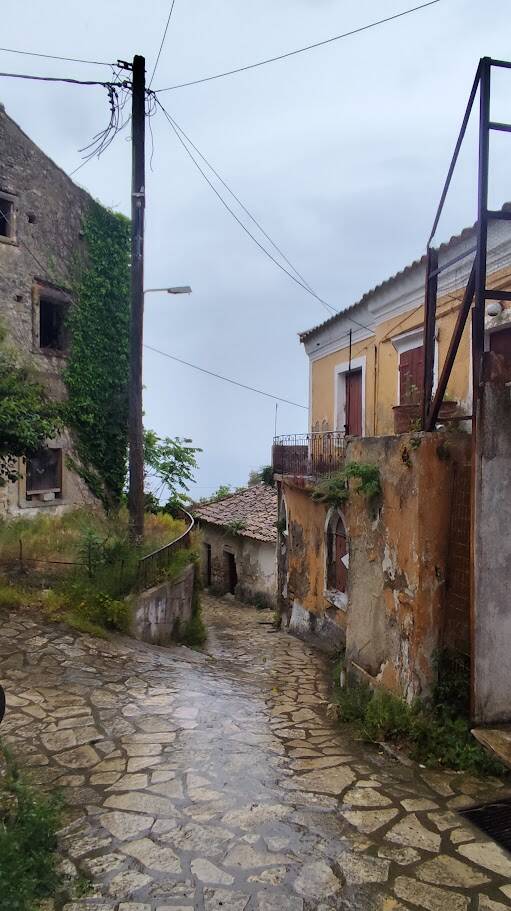
The architecture and urban structure of Chlomos reflect the island’s long Venetian heritage. Corfu remained under Venetian rule from 1386 until 1797, a period that left an indelible mark on its society, economy, and built environment. The village’s narrow, winding lanes, the famous kantounia, steep stone stairways, arched passages, and two-storey stone houses painted in vivid colours beneath traditional tiled roofs are characteristic of Corfiot rural architecture shaped by the Venetian period. Their dense, protective arrangement echoes the historic neighbourhoods of Corfu Town, where architecture developed not only according to aesthetic principles but also in response to the need for security and communal defence.
Among the historic buildings of Chlomos is the mansion associated with Thomas Palaiologos, brother of the last Byzantine Emperor, Constantine XI Palaiologos. It remains as a silent witness to the importance of the settlement during one of the most turbulent transitional periods in Greek history.
There are two principal local theories concerning the origin of the village’s name. The first connects it with the word Flomos (Verbascum), the yellow-flowering wild mullein that grows upon the rocky mountain slopes surrounding the settlement. The plant has long held a place in folk tradition and herbal practice. According to this theory, the name gradually changed through the local dialect, with the initial Ph sound evolving into the Ch of Chlomos, linking the name of the village directly to the landscape from which it emerged.
The second theory concerns the appearance of its earliest inhabitants. According to local tradition, a severe epidemic (possibly malaria) once afflicted the marshy lowlands of southern Corfu. The disease drove inhabitants towards the higher ground of the mountain, where they sought the cleaner and healthier air of the uplands. Their health eventually improved in the mountain climate, but when the settlers first arrived, they were said to have been exceptionally pale and weakened by illness. This gave rise to the popular explanation that the settlement became known as Chlomos, the “village of the pale ones.”
During the Venetian period, Chlomos developed into an important agricultural estate and local economic centre, dominated by large landowners and cultivators. Venetian economic policy discouraged grain production and strongly encouraged olive cultivation, offering financial incentives for the establishment of new olive groves. Over time, this transformed the landscape surrounding Chlomos, incorporating it into the vast network of olive groves that would eventually make Corfu one of the Mediterranean’s major olive-oil producing regions.
Following the fall of the Venetian Republic, Corfu entered a period of successive political transformations. The island passed under French republican and imperial administration from 1797 to 1814, followed by British protection from 1815 to 1864, before the final union of the Ionian Islands with the Greek state in 1864. Despite these sweeping political changes and the pressures brought by the modern world, Chlomos retained much of its traditional character and distinctive identity.
Today, the village remains a living testimony to Corfu’s layered history: Byzantine, Venetian, French, British, and Greek influences coexist within its architecture, landscape, customs, and collective memory. Its old stone houses, winding kantounia, mountain setting, and surrounding olive groves preserve an atmosphere in which the past has never entirely disappeared, but continues to exist within the life of the village itself.
The Church of the Taxiarchs
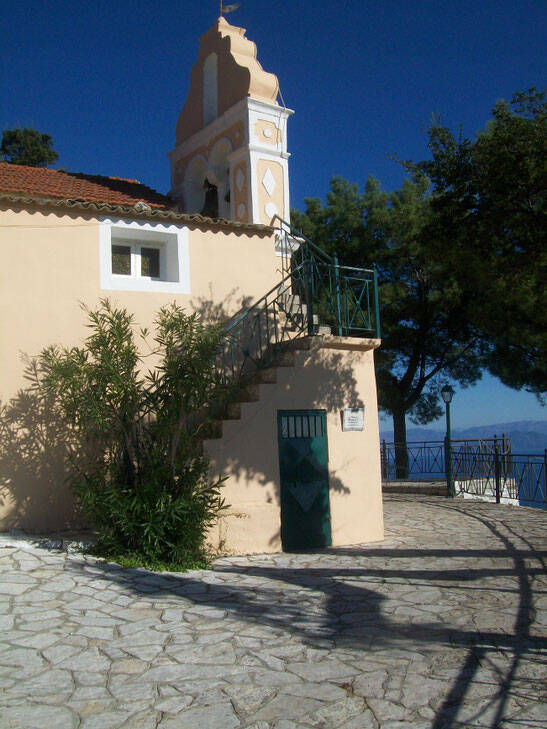
Among the many churches of Chlomos, one holds a particularly special place in my heart and in my practice, the Church of the Taxiarchs. According to local tradition, the church was built in the 14th century directly upon the remains of an ancient altar dedicated to Apollo. Ancient sacred sites were rarely established without reason, as they were often associated with places believed to possess particular natural or spiritual significance, and from this perspective, the later Christian occupation of such a site can be understood as part of a much older sacred geography. The early Christians built their church upon the ancient altar and, in doing so, sought to redirect, transform, or seal the spirit of the place, the genius loci that had developed through centuries of pagan worship.
Inside the church, the original Byzantine apse remains preserved, featuring at its center the fresco of the Archangel Michael. This choice reflects a broader historical pattern, as altars once dedicated to Apollo were routinely overtaken by temples built for the Archangel. In a very real sense, Michael is Apollo under a new Christian mask, continuing the same solar guardianship and spiritual lineage. Directly behind the building lies the village cemetery, where the dead of Chlomos have been laid to rest since approximately 1600. Generations of ancestors resting within this ground give the site a distinct spiritual character, creating a powerful point of contact between the living, the dead, and the older currents associated with the hill itself. The church, the cemetery, and the land surrounding them form a continuous sacred landscape in which different layers of memory and belief overlap.
Whether one understands this in historical, symbolic, or magical terms, the significance of the place remains the same within my own practice. The ancient sacred geography of the hill was never simply erased, but rather transformed and covered by new names and new images while the land itself remained. In this sense, the old current of the mountain continues to live beneath the later religious forms that came to occupy it.